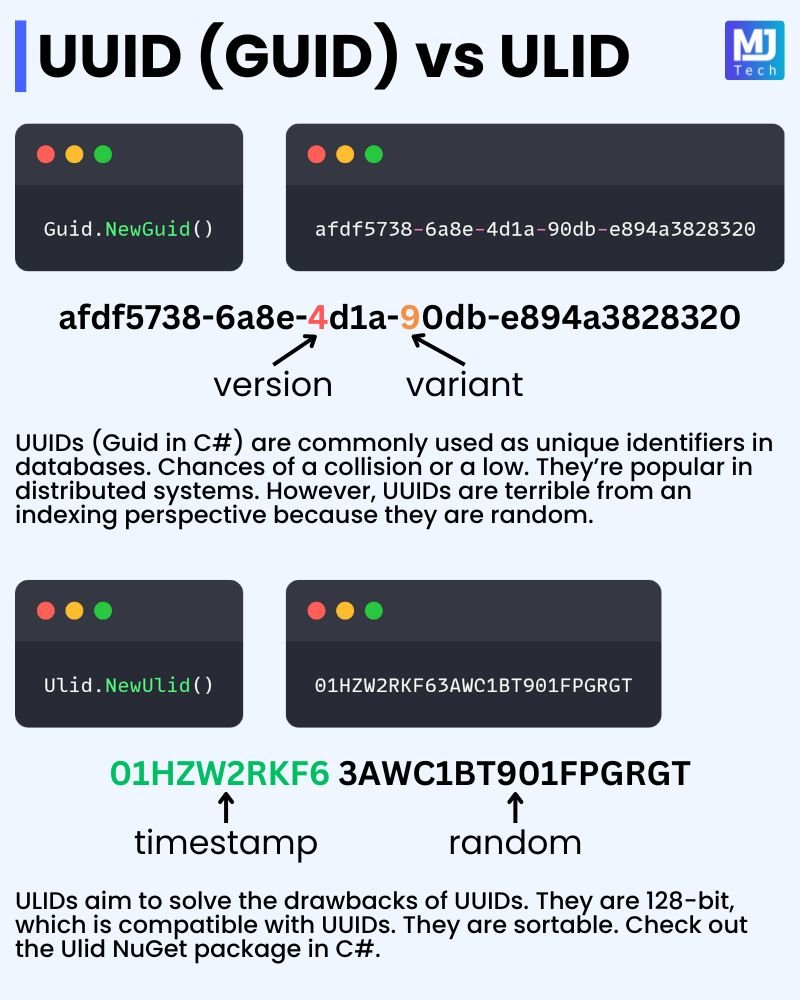
Should you stop using UUIDs?

UUIDs (Guid in C#) are widely used as unique identifiers in databases. UUIDs are random, which makes them popular in distributed systems.
However, UUIDs have some drawbacks:
UUIDs slow down database inserts. Each insert must update the clustered index, a B+ tree. Because UUIDs are random, this is an expensive operation as it requires rebalancing the tree
Higher storage costs. A UUID is 128 bits long, and it's even longer if you store it in human-readable format as a string.
So, let me introduce you to ULIDs.
ULID attempts to solve the drawbacks of UUID. It's also 128-bit, so it's compatible with a UUID. However, unlike a UUID, ULIDs are sortable. The first 40 bits of a ULID represent a timestamp, making ULIDs monotonically increasing.
There's a .NET package that implements the ULID spec, so you can start using it immediately. However, you'll need to write some code if you want ULID to work with popular ORMs.
What do you think about ULIDs?